A humming sound grows louder as you drive, but the engine seems to run normally. The noise may change during a gentle turn or become harder to hear on rough pavement. A worn wheel bearing is one possible cause, although tire tread and other rotating components produce similar sounds. Learning the differences helps you describe the noise without guessing which wheel needs replacement.
Why Wheel Bearings Make Noise as They Wear
Wheel bearings support the wheel and hub while allowing consistent, low-friction rotation under vehicle weight and cornering forces. Inside the bearing, hardened rolling elements move along precisely shaped surfaces. When lubrication deteriorates, contamination enters, or those surfaces become damaged, rotation is no longer as quiet or consistent. A worn bearing often produces a low hum, growl, or rumble that follows vehicle speed.
The sound sometimes begins faintly and becomes more noticeable over several weeks. A bearing can also deteriorate without making the classic noise. During an inspection, we consider sound, play, and operating behavior together. The goal is to identify the affected hub or related component before recommending replacement, not to rely on one particular noise description.
Humming and Growling Usually Follow Road Speed
A typical bearing noise becomes faster or louder as the wheels turn more quickly. It may remain present when you ease off the accelerator, unlike some engine or drivetrain noises that change mainly with load. The pitch can rise with speed, then blend into road noise at highway pace. Because the sound travels through the vehicle body, it may seem to come from the wrong side.
Does the noise continue when you coast at a steady speed? That observation helps narrow the investigation, although you shouldn't perform unsafe driving experiments. We compare the sound with tire condition, hub behavior, and relevant drivetrain components during a focused inspection. A transmission bearing and a damaged tire can imitate some of the same sounds.
Turning Can Change the Sound, but Doesn't Prove the Side
When a vehicle turns, weight shifts between the wheels. A worn bearing sometimes grows louder when additional load reaches it and becomes quieter when that load decreases. Drivers often use this pattern to guess which side has failed. However, steering geometry, tire wear, and vehicle design influence the sound, so a turning test isn't a reliable part-identification method on its own.
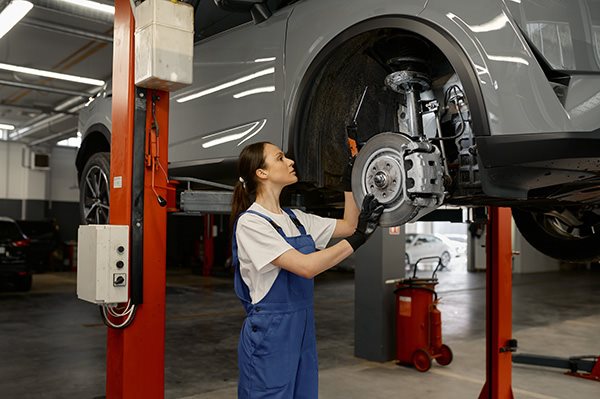
A careful road test is only one part of the process. We inspect the hub and wheel assembly and check for abnormal movement where the manufacturer's procedure allows it. Some failing bearings have no obvious looseness, especially early in the failure. Don't assume a quiet bearing is safe or that every growl during a turn comes from the front axle.
Tire Noise Is a Common Lookalike
Uneven tire wear, cupping, and aggressive tread patterns produce humming that changes with speed. A tire sometimes becomes louder on certain pavement types or as its tread wears. Wheel alignment faults, weak dampers, and incorrect tire pressure contribute to irregular wear. Replacing a bearing won't correct a tire whose tread is producing the noise.
During an inspection, the tires need a close look for abnormal wear and physical damage. Rotating the tires, when permitted, may change the location of a noise, which helps distinguish it from a fixed hub problem. We also check for bent wheels and nearby brake concerns. Routine maintenance that includes tire rotation and pressure checks helps identify these issues before they become severe.
Brake and Drivetrain Problems Also Need Consideration
Dragging brake pads, a bent backing plate, or damaged brake hardware can produce rubbing or scraping that resembles wheel-end trouble. CV joints often click during turns, while certain differentials whine under load. The sound's timing helps separate these faults, but they sometimes overlap. A new noise after recent brake or axle service calls for a closer examination of the affected area.
Tell us if the sound changes while lightly braking, accelerating, or steering. Those clues help focus inspection on the right components. A grinding sound accompanied by heat from one wheel or a change in braking performance needs prompt service. Continued driving through a severe wheel-end fault risks damaging other parts and compromising control.
Warning Signs That Change the Urgency
An early hum that has not affected handling still calls for timely evaluation. A bearing with significant damage can develop excess play, heat, or rough rotation. Severe cases risk loss of proper wheel support.
A strong vibration, noticeable wobble, or sudden change in steering behavior is more urgent than a faint noise alone. Stop safely and arrange transport if the vehicle feels unstable.
Report these observations when arranging service:
Don't test a suspected failing bearing through repeated high-speed turns. A professional inspection can determine how serious the problem is without adding unnecessary risk.
What Replacement and Verification Involve
Some vehicles use a complete bolt-on hub and bearing assembly, while others require pressing a bearing into the steering knuckle. Correct tools and installation procedures are critical. Overtightening, incorrect torque, or damaging a bearing during installation creates problems that a new part cannot overcome. Certain hubs also carry wheel-speed sensors or magnetic encoders used by ABS and stability systems.
After repair, we confirm that the original noise has disappeared and check for related wheel, brake, or sensor faults. Proper maintenance of the tires and suspension reduces other sources of wheel-end noise, though it cannot prevent every bearing failure. An accurate inspection helps you know when replacement is necessary and prevents paying for a hub that wasn't the cause.
Get Wheel Bearing Inspection in Portland, CT, With Portland Automotive
Portland Automotive in Portland, CT, investigates wheel-bearing noise, hub wear, tire sounds, and related handling concerns. We'll explain the inspection findings and the repair options.
Call Portland Automotive or schedule a wheel bearing inspection online today.