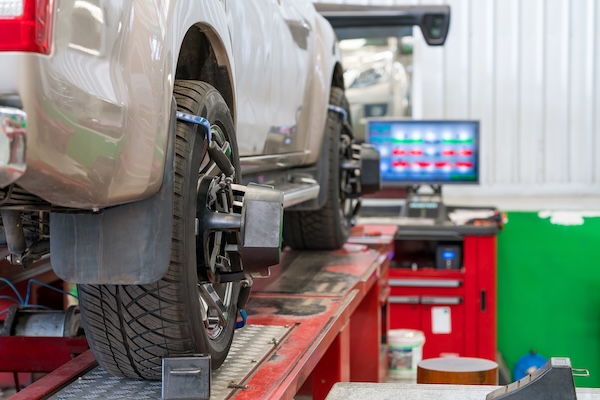
A lot of drivers think of wheel alignment as a pretty straightforward service. The angles get adjusted, the steering wheel gets centered, the tires stop wearing unevenly, and you are back on the road. That is still true in many ways, but on newer vehicles, there is often another important step that can come into play after alignment work: sensor recalibration.
At Portland Automotive, this is something we explain more and more often. Modern vehicles are loaded with technology that depends on accurate positioning. Lane-keeping systems, forward-facing cameras, steering angle sensors, adaptive cruise control, stability control, and collision warning systems all rely on the vehicle knowing exactly where “straight ahead” really is. If the alignment changes and the system is still working off old reference points, the electronics may not interpret the road the way they should.
That does not mean every wheel alignment automatically requires every sensor to be recalibrated. But it does mean that on many vehicles, especially newer ones with advanced driver-assistance systems, the alignment and the sensor setup are more connected than people realize.
Why Alignment And Sensors Are Connected
A wheel alignment changes the direction the wheels point in relation to the vehicle and the road. That affects things like toe, camber, and caster. From a mechanical standpoint, those adjustments help the car track properly, keep the steering wheel centered, and reduce uneven tire wear.
The reason sensors come into the picture is that many vehicle systems are built around a known center position or reference angle. If the steering wheel was off-center before the alignment, or if suspension or steering components were replaced before alignment work, the vehicle’s sensor data may no longer match the corrected physical setup.
In plain language, the vehicle may think straight is one thing, while the wheels and steering are now physically set to another. That mismatch is where recalibration matters.
The Steering Angle Sensor Is One Of The Big Ones
One of the most common sensors involved after alignment work is the steering angle sensor. This sensor tracks the position of the steering wheel and tells the vehicle how much, and in what direction, the wheel is being turned.
That information is used by systems like:
- Electronic stability control
- Traction control
- Lane-keeping assist
- Some adaptive steering systems
If the steering angle sensor is not reading correctly after alignment or steering repairs, the vehicle may misinterpret driver input. In some cases, that can trigger warning lights. In others, it can affect how stability or assistance systems behave.
This is why centering the steering wheel properly during the alignment is such a big deal. On many vehicles, once the wheel is centered and the alignment is correct, the steering angle sensor may need to be reset or recalibrated so the computer recognizes the new centered position.
Camera And ADAS Systems May Need Calibration Too
On vehicles equipped with advanced driver-assistance systems, the front-facing camera is another major player. This camera is often mounted near the windshield and is used for features like lane departure warning, lane centering, traffic sign recognition, and forward collision alerts.
Those systems rely on a precise understanding of where the vehicle is pointed. If alignment angles have changed, especially after suspension work or accident repair, the camera may need recalibration so its field of interpretation matches the corrected path of the vehicle.
This can involve either:
- Static calibration, where the vehicle is set up indoors with targets and measurement equipment
- Dynamic calibration, where the vehicle is driven under specific road conditions, so the system can relearn
Some vehicles require one method, some require the other, and some require both, depending on the manufacturer and what repairs were done.
Recalibration Is Not Just Plugging In A Scan Tool
This is one of the biggest misconceptions we hear. People assume recalibration is just clearing a light or pressing a reset button. In reality, proper recalibration can be much more involved.
At a high level, the process often includes:
- Completing the alignment first
- Confirming tire pressure and ride height are correct
- Centering the steering wheel accurately
- Using scan tools to access the system
- Following manufacturer-specific calibration procedures
- Performing static or dynamic calibration if required
The important detail here is that it has to be done in the right order. You do not recalibrate first and align second. The mechanical side has to be right before the electronic systems can be taught the correct reference point.
When Sensor Recalibration Is Most Likely To Be Needed
Not every car on the road needs extensive recalibration after a basic alignment. Older vehicles without ADAS features may only need alignment and steering wheel centering. But newer vehicles often need more attention, especially if other work has been done.
Recalibration is more likely to be needed after:
- Suspension component replacement
- Steering component replacement
- A wheel alignment on a vehicle with ADAS features
- Accident or impact repairs
- Steering angle sensor faults or warning lights
- Windshield replacement on vehicles with camera-based systems
This is why we look at the whole vehicle, not just the alignment rack numbers. If the car has systems that depend on direction, angle, or lane position, we need to think beyond the tires and tie rods.
How We Know If A Vehicle Needs It
At our shop, we start with the vehicle itself. The year, make, model, and equipment level matter. Some vehicles have advanced features that absolutely require calibration after certain types of work. Others are less demanding.
We also look at what prompted the alignment in the first place. Was it just routine tire wear correction? Or was it preceded by suspension work, a curb hit, steering repairs, or warning lights? Those details matter because they tell us how likely it is that the vehicle’s sensor references have been disturbed.
In many cases, the vehicle’s service information spells out exactly what is required. That is what we follow. This is not the kind of thing we guess at, because modern systems are too interconnected for that.
Why This Matters More On Newer Vehicles
The more technology a vehicle has, the more likely it is that alignment and electronic calibration are linked. Years ago, an alignment was mostly a mechanical correction. Today, it can also be part of restoring the vehicle’s digital sense of direction.
That does not mean the process has become overly complicated for no reason. It means newer cars use electronics to assist with safety, and those electronics only work properly when the mechanical setup underneath them is correct.
From our perspective, that is the real takeaway. Alignments still matter the way they always did, but on newer vehicles, the finish line may include sensor recalibration, too.
If your vehicle needs an alignment, suspension work, or has warning lights related to steering or driver-assistance systems, bring it to Portland Automotive in Portland, CT. We can inspect the alignment, determine whether recalibration is needed, and make sure both the mechanical and electronic systems are working together the way they should. Call us today or stop by to schedule an inspection.