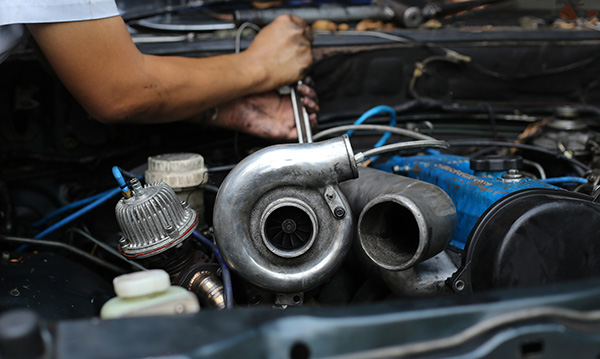
A turbocharged engine already has a radiator removing heat from the cooling system, so it is reasonable to wonder why another heat exchanger is needed. From the outside, the radiator and intercooler can even look similar, especially when both are mounted behind the front grille.
They are cooling two different things. The radiator controls engine coolant temperature, while the intercooler removes heat from the compressed air traveling from the turbocharger toward the engine. A turbocharged engine needs both because controlling coolant temperature does not automatically keep the intake air cool.
The Radiator Cools the Engine, Not the Intake Air
Engine coolant circulates through passages in the engine, absorbing heat from the cylinder block and cylinder heads. The hot coolant then travels to the radiator, where airflow carries much of that heat away.
That system protects the engine from overheating, but the intake air does not normally pass through the radiator. Even if coolant temperature is perfectly normal, air leaving the turbocharger can still be extremely warm. That is why adding a turbo creates a separate heat-control problem that the main radiator was never intended to handle.
A Turbocharger Heats Air as It Compresses It
The turbocharger uses exhaust energy to spin a turbine connected to a compressor wheel. That compressor packs more air into the engine so it can burn additional fuel and produce more power.
Compressing air raises its temperature. The turbocharger is also mounted close to very hot exhaust components, so the surrounding heat does not help. During sustained boost, repeated acceleration, or a long uphill drive, charge-air temperature can climb quickly even while the coolant gauge stays right where it belongs.
The Intercooler Takes Heat Out Before Combustion
After leaving the turbocharger, the compressed air is routed through the intercooler before it enters the intake manifold. The intercooler gives that heat somewhere else to go.
Many vehicles use an air-to-air intercooler. Outside air moves across cooling fins while the hot compressed intake air passes through the core.
Other vehicles use an air-to-water setup. In that design, a separate liquid circuit absorbs heat from the intake charge and releases it through another heat exchanger. It may look more complicated because it can include:
- A dedicated coolant pump
- Intercooler coolant hoses
- A separate reservoir
- A front-mounted heat exchanger
- Temperature sensors and control valves
That intercooler cooling circuit still does a different job than the main engine radiator.
Cooler Air Helps the Engine Make Power More Consistently
Cooler air is denser than hotter air. That means a cooler intake charge contains more oxygen in the same amount of space, which is exactly what a turbocharged engine wants when it is making a boost.
High intake temperatures can also increase the chance of abnormal combustion. The engine computer watches temperature and knock-related data and can reduce ignition timing or boost when conditions get too hot. From the driver's seat, the vehicle may feel strong during the first acceleration and then less responsive after several hard pulls.
At our shop, that type of power loss gives us a reason to compare intake temperature, boost pressure, coolant temperature, and other engine data. A normal radiator temperature does not rule out a charge-air cooling problem.
What Happens When the Intercooler System Has a Problem?
Intercooler problems do not always cause the engine to overheat. Instead, you may notice reduced power, inconsistent boost, or a warning light.
Common problems include:
- Cracked intercooler tanks
- Loose charge-pipe clamps
- Split boost hoses
- Bent or blocked cooling fins
- Leaks in an intercooler coolant circuit
- A failed intercooler coolant pump
- Oil contamination inside the core
A leak can be especially noticeable during acceleration because the charge pipes are under pressure. The car may feel weak, and you might hear a hiss or rushing-air sound when boost builds.
Why a Bigger Radiator Does Not Replace an Intercooler
Installing a larger engine radiator can improve coolant heat rejection in the right application, but it still does not directly cool the compressed intake charge. The two systems solve different heat problems.
The reverse is also true. A large intercooler cannot compensate for a failing radiator, weak cooling fan, leaking water pump, or low engine coolant. During an inspection, we treat engine cooling and charge-air cooling as related but separate systems.
Regular maintenance helps catch damaged hoses, coolant leaks, clogged cooling surfaces, and loose connections before they affect performance. On turbocharged vehicles, keeping both cooling systems healthy helps keep temperatures under control.
Get Turbocharger And Intercooler Service In Portland, CT, With Portland Automotive
If your turbocharged vehicle feels weaker under boost, loses power as it gets hotter, or has developed an intercooler or cooling-system warning, Portland Automotive in Portland, CT, can check both the engine cooling system and charge-air system.
Schedule a visit and find out whether the problem is coming from the radiator, intercooler, turbo plumbing, or another part of the cooling system.